QUESTIONS AND ANSWERS ABOUT YACHT CHARTER IN MALLORCA
Yes. Our provisions shop allows you to arrange your grocery order from home before departure. A selection of ready made packages is available for your convenience. Your ordered supplies will be delivered directly to your yacht.
You can access the shop via the customer login area. Delivery is available to our charter bases in Can Pastilla and Palma.
Your anchor and chain should be laid on sandy seabed, not on protected seagrass. Compliance with this rule is monitored regularly, particularly during the season. Breaches can result in substantial fines.
If you would like to circumnavigate Mallorca in full and still have enough time to enjoy its varied stretches of coastline, you should allow around two weeks. The island’s coast is wonderfully diverse and offers many places well worth a longer stop.
Crews with a more ambitious sailing schedule can also complete the circuit within one week. However, this usually requires long passages and many hours under engine if the wind is not in your favour. The world record mentioned in the original FAQ stands at 13 hours, 15 minutes and 17 seconds. How much of the scenery that crew actually had time to admire has not been recorded.
If you are departing from Palma, the south coast is particularly well suited to a one week charter. In the southeast, highlights include the long sandy beach of Es Trenc, the protected island of Cabrera with its crystal clear water, and the many coves stretching along the coast as far as Portocolom.
To the southwest, attractive options include an overnight stay in Cala del Mago, a circumnavigation of Dragonera with its dramatic cliffs, and bays such as Camp de Mar. Port d’Andratx is also a rewarding destination, with restaurants overlooking the sea.
Your initial direction of travel, and whether you continue further north, should always depend on the prevailing weather and wind conditions.
Which fishing licence do I need?
A local service fee of currently €75 per trip is charged for issuing the licence. The licence should be requested no later than one week before the start of your charter. The number of people fishing on board does not affect this.
Recreational fishing, known in Spanish as “pesca recreativa”, is divided into several categories in the Balearic Islands. Children up to the age of 14 may fish free of charge without a licence. People aged 65 and over must still apply for a licence, but no fee is payable.
For fishing from shore or from small floating craft such as kayaks, canoes or pedal boats, the required permit is the “licencia de pesca marítima recreativa individual”. It is valid for three years. Separate licences apply to spearfishing, “pesca submarina”, fishing from larger boats, “pesca de embarcación”, and sport fishing, “pesca deportiva”.
Where is fishing permitted in Mallorca?
The waters around Mallorca are divided into coastal waters, “aguas interiores”, and marine protected areas, “reservas marinas”. Special regulations apply within protected areas.
Between 1 May and 30 September, fishing from the beach is prohibited between 7:00 and 22:00. It is also forbidden within 100 metres of bathers, within a radius of 250 metres of commercial fishermen, in specially protected zones, around Dragonera, and in the Cabrera National Park.
Fishing is permitted in certain marine protected areas around the island, subject to specific conditions. An overview can be found in the relevant angling app or under “Cuaderno pesca recreativa”. On land, some protected areas are marked by white pillars. During official inspections, however, GPS coordinates are decisive.
According to Bernadí Alba, quoted in the original FAQ, there is no single best fishing spot. Fish can generally be found everywhere. What matters most is using the right bait and choosing the right location. In summer, fish are often found further offshore. In winter, fishing closer to the coast can be more rewarding.
How much may I catch, and what species are allowed?
In addition to fish, cephalopods such as squid and certain invertebrates may also be caught. Per licence, the catch is limited to five kilograms plus one additional specimen. For boats, the upper limit is 25 kilograms plus one specimen.
Minimum sizes apply to various fish species, and these differ between ordinary coastal waters and protected areas. Fish are measured from the mouth to the tip of the tail fin. Specimens below the minimum size must be released back into the sea. Catches from protected areas must be reported via the designated app.
Which animals must not be caught?
Crustaceans such as spiny lobster and prawns, as well as shellfish and sea snails, may not be caught or collected. Additional restrictions also apply to certain fish species.
Some species must be marked after capture in order to prevent illegal sale by recreational anglers. This is done by removing part of the lower tail fin without altering the length relevant to the minimum size. Examples mentioned in the original FAQ include greater amberjack, red scorpionfish, and brown meagre.
Sharks and rays must not be caught. For some other species, conservation rules allow no more than one specimen per day and per licence. A special government permit is required for bluefin tuna, spearfish, Mediterranean spearfish, hake, albacore, swordfish, and bigeye tuna.
The well known Mallorcan raor, also called pearly razorfish, may only be caught from 1 September to 31 March. Professional fishing methods such as trawl nets are not permitted for recreational anglers.
When is a good time to fish?
In principle, recreational anglers are not restricted by day of the week or time of day. In the original FAQ, Bernadí Alba describes February as less favourable due to cold conditions, unsettled seas, and rapidly changing weather. Spring and early summer are likewise not regarded as peak season there, partly because many fish spawn in April and May. The period from late August to late December is considered especially good.
The crew list must be submitted in full before departure.
Copies of passports, identity cards, and licences are not requested or stored in advance. However, you must carry these documents with you during your trip. Before the charter begins, we require only the personal details requested in the crew list.
In Mallorca, there are three main types of harbour: private marinas, Club Náuticos, and municipal ports.
According to the original FAQ, you should allow roughly €50 to €100 per day, depending on the harbour and the size of the yacht. Water and electricity may be charged separately in addition to the berth fee. The most economical berths are generally found in municipal ports.
A harbour guide is also available in the customer login area. It covers marinas, anchorages, and buoy fields, and includes aerial photographs and price information to help you plan your trip.
According to the original FAQ, Mallorca does not offer a consistently practical system for reserving berths well in advance. The state run platform at www.portsib.es is available only for yachts up to 15 metres and only for selected ports. Its use is described there as relatively complicated.
For that reason, the recommended approach is to reserve your berth by telephone once your actual route and the latest weather forecast are clear. The “Portbook” on board contains the telephone numbers of the marinas. According to the original FAQ, this method has proved both simple and reliable.
We will be pleased to arrange a buoy reservation in Cabrera on your behalf. The necessary information can be entered in the customer login area.
From a meteorological perspective, Mallorca and Menorca display typical Mediterranean conditions. Ibiza and Formentera, by contrast, show a stronger subtropical influence.
One of the key winds is the Mistral, known in the Balearics as the Tramontana. It can set in suddenly, usually blows strongly from the northwest to north, and is often accompanied by clear skies. In some cases, high cirrocumulus clouds, sometimes called mackerel skies, signal its arrival.
The Levante often brings thin cloud cover and poor visibility. Ponente and Libeccio are usually weaker and shorter lived. The Scirocco, on the other hand, can arrive with considerable force. It is humid and develops in connection with weather systems along the North African coast.
From November to February, the original FAQ describes the weather in Mallorca as comparatively stable. During this period, Tramontana and Grecale are the prevailing winds. March, September, and October are considered especially windy. At the start of autumn, Libeccio and Ponente are particularly common. Storms may follow the Mistral more frequently.
In summer, Scirocco and Levante tend to dominate and can locally reach the strength of typical thermal breezes. In spring, Ponente and Mitjorn occur more often, with Mitjorn blowing from the south.
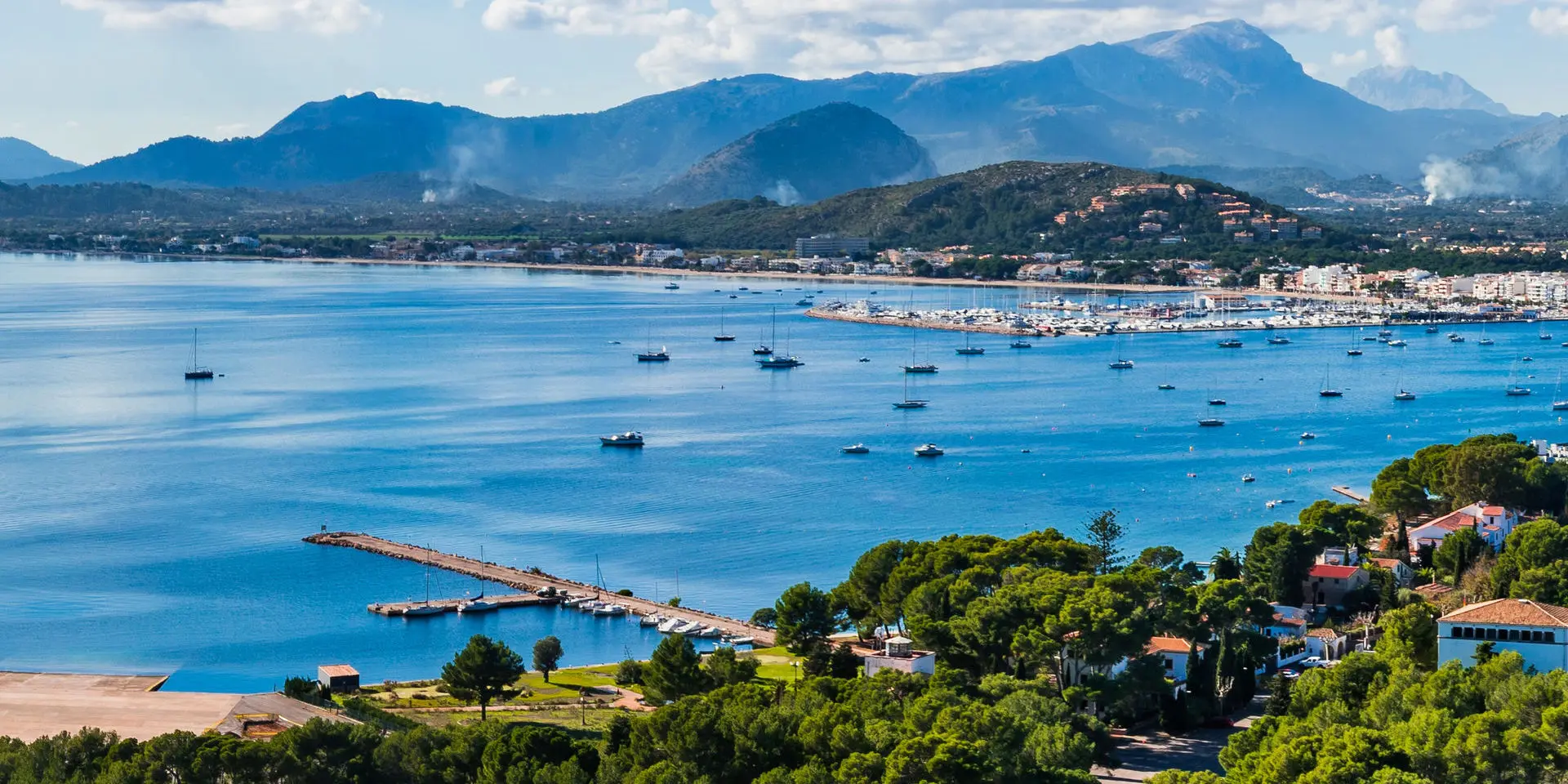
In the bays of Palma, Pollença, and Alcúdia, warm local winds develop on a small scale. They usually begin around 10:00, reach their greatest strength between 14:00 and 15:00, and ease again by about 17:00.
According to the original FAQ, winds in Ibiza and Formentera are generally lighter than around the other islands. The influence of the Mistral and Tramontana is weaker there, while the Levante can be stronger. In summer, areas of complete calm may form in the Bay of San Antonio de Abad and in the northwest of the island during Scirocco and Mitjorn conditions.
The standard handover takes place on Saturday from 15:00 onwards. After your trip, you return to base on Friday evening and may spend the final night on board. Check out takes place on Saturday morning at 08:00.
For a small number of yachts, an “early check in” is available for a modest surcharge. In these cases, handover can take place from 12:00 onwards.
The skipper must hold at least the German SBF See licence, or an equivalent qualification, together with appropriate sailing experience.
A nationally recognised marine radio certificate, preferably the SRC, is generally required. According to the original FAQ, however, this is not currently checked in Mallorca. A pyrotechnics certificate of the type sometimes required on the Baltic Sea is not needed in Mallorca.
Alongside the current German Sportbootführerschein See and Binnen licences, many older national licences are still in circulation. Within Germany, these older licences generally remain valid. Abroad, the situation may differ. For that reason, the original FAQ recommends converting them into the newer format. In the case of Croatia, it notes that in some instances only the newer licences are recognised.
Examples of older offshore and coastal licences
- DMYV motorboat licence for German sea waterways, issued from 1967 to 1973
- DMYV or DSV sport boat licence for German sea waterways, where the cover page sometimes states only “Sportbootführerschein” rather than “See”
- DSV association licences such as the A licence, BR licence, BK licence, C licence, and R licence
- State of Berlin motorboat licence, valid only in Berlin
- Boating licences issued in the former GDR
Anyone who already holds an official German Sportbootführerschein See may, under the relevant conditions and within the applicable deadlines, convert certain older association licences. Examples mentioned include converting the BR licence to the Sportküstenschifferschein, SKS, or to the Sportseeschifferschein, SSS, as well as converting the C licence to the Sporthochseeschifferschein, SHS.
Examples of older inland licences
- DSV inland navigation licence A with motor authorisation. The sailing section of the former inland licence A can be converted into the German Sportbootführerschein Binnen for sailing boats.
- DMYV motorboat licence A for inland navigation
According to the original FAQ, conversion is possible via the licensing office of the German Sailing Association. Fees there are stated as between €19 and €29.
For the various conversions, the old FAQ refers to the relevant application forms for SBF See, SBF Binnen, the conversion of SBF See and BR to SKS, and the conversion of the BK or C licence to SSS or SHS.